Why muzzle velocity accuracy breaks or makes long‑range hits
True muzzle velocity is the foundation of every long‑range fire solution. It is the starting number your ballistic solver uses to predict drop, wind drift and time of flight. If that number is off by even a small margin, the error compounds as distance grows and shows up as full‑target‑height misses at 800 m and beyond.
Think about a common 6.5 mm long‑range load. A shift of just 15–20 ft/s in assumed velocity can move predicted impact by roughly 0.2–0.3 mrad at 1,000 m — enough to miss a small steel plate. Traditional chronographs often read velocity a few metres in front of the muzzle and call it “muzzle velocity,” baking in a systematic error from the outset. When you then “true” your solver by guessing at BC or tweaking velocity, you are correcting guesses with guesses.
Modern ballistic thinking has shifted. As Bryan Litz notes in his discussion of calibration, advances in chronograph technology have reduced uncertainty in muzzle velocity, exposing drag model error as the next major source of miss distance. Radar‑grade systems go one step further: they do not just tighten the MV number; they measure the projectile’s entire velocity‑versus‑distance curve, letting you base your solution on how your bullet actually flies from your barrel in today’s air.
The pain point for serious shooters is simple and specific: they are tired of burning boxes of ammunition to walk impacts onto target because the underlying data is approximate. The EB‑MK ONE exists to turn that guesswork into measured fact, shot by shot, across real atmospheric conditions.
How Doppler radar measures the full flight, not a single point
Doppler radar ballistic analyzers work by transmitting a continuous microwave signal downrange and listening for the echo from the projectile. Because the projectile is moving, the frequency of the reflected signal shifts in proportion to its velocity — the same Doppler effect that makes an ambulance siren sound higher‑pitched as it approaches and lower‑pitched as it leaves.
The critical difference from a point chronograph is continuity. Instead of registering a single “shadow break” between two sky screens or a one‑time magnetic disturbance at the muzzle, the radar tracks the bullet repeatedly as it travels through its detection volume. The result is a dense series of velocity samples at known distances, which the EB‑MK ONE turns into a velocity‑versus‑distance profile for every shot.
From that curve, several high‑value quantities fall out. First, the system computes true muzzle velocity by extrapolating the measured curve back to the crown rather than reading speed a few metres ahead and guessing backwards. Second, you see real drag behaviour — how your specific bullet slows down in your specific barrel in that day’s pressure, temperature and humidity.
Finally, the radar derives a measured ballistic coefficient that describes your system, not an industry average. This matters because manufacturer BCs are often optimistic and are usually reported as single numbers across wide velocity bands. Independent testing, including work highlighted in modern calibration articles such as The Evolution of Ballistic Calibration, shows that using an incorrect drag model quickly opens a gap between predicted and real trajectories at long range.
By measuring the flight rather than inferring it from a single point, Doppler radar collapses both MV and BC uncertainty. Your solver is fed with inputs that already reflect reality, so truing becomes verification, not damage control.
Chronographs compared: optical, magnetic and Doppler radar
Ballistic chronograph technologies fall into three practical families: optical skyscreen systems, barrel‑mounted magnetic bayonets, and modern Doppler radar units like the EB‑MK ONE. All can report a number; only one class measures the flight.
Optical chronographs place two light screens a fixed distance apart downrange. As the bullet passes through, its shadow triggers the sensors, and the unit divides distance by time to compute average velocity over that short base. Anyone who has fought with them knows the weaknesses: readings swing with sky conditions and artificial lighting, setup requires a cold range, exact alignment with the bore is critical, and the entire assembly sits in the line of fire. It is no accident that many skyscreen housings bear bullet scars from low shots.
Magnetic barrel‑mounted chronographs solve the lighting problem by clamping a sensor bayonet directly to the barrel. They detect the projectile passing through a shaped magnetic field and output near‑muzzle velocity. The trade‑off is mechanical: mass hanging on the barrel alters barrel harmonics, which can move point of impact and change group shape. You end up characterising a rifle that is not quite your rifle. Each firearm also demands its own setup, and small differences in bayonet position can nudge readings.
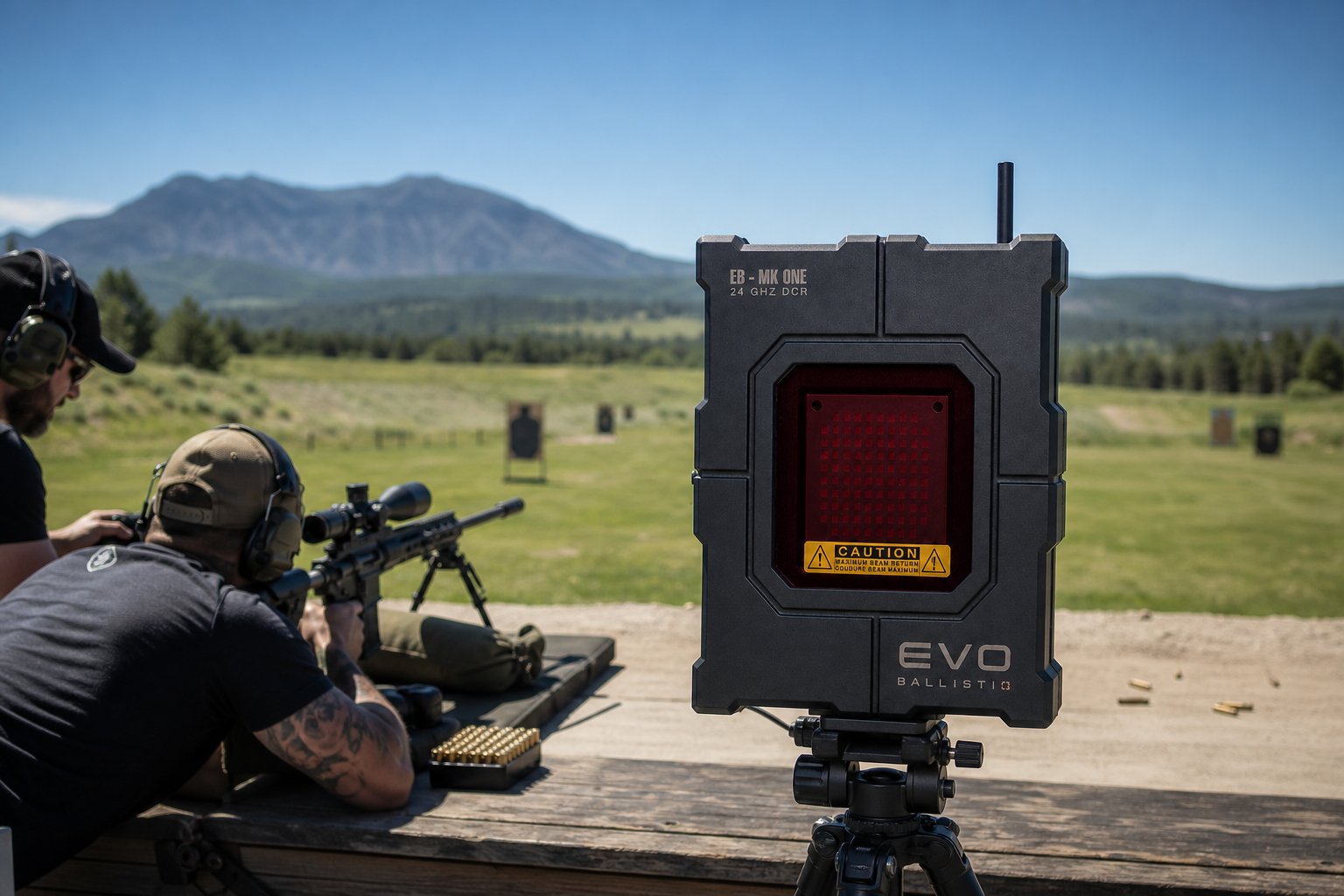
Doppler radar breaks out of both traps. The EB‑MK ONE sits beside the shooter on a bench or tripod, aimed downrange. Nothing is attached to the barrel, so harmonics and zero remain untouched. Nothing is placed downrange, so no cease‑fire is required and nothing can be shot. Because radar energy, not ambient light, carries the signal, indoor ranges, overcast days and last‑light zeroing all produce the same quality of data. Critically, a single unit can serve an entire firing line without reconfiguration, letting an armourer log dozens of rifles’ velocities in one session.
From a purely measurement‑science perspective, only the radar generates the continuous data needed to compute measured BC and drag. The others remain single‑point tools.
Who truly needs radar‑grade ballistic data (and who doesn’t)
Radar‑grade ballistic data earns its place when small errors in velocity or drag change your outcome. If your goals sit inside that envelope, the EB‑MK ONE is an instrument, not a toy. If they do not, an honest evaluation often says you can wait.
The clearest use case is genuine distance. Once you are stretching beyond mid‑range, trued velocity and measured BC become the line between first‑round hits and chasing splash. A shooter building capability to 1,000 m and beyond gets immediate value from feeding their solver radar‑measured inputs instead of optimistic box velocities and generic drag models.
Serious handloaders are another natural audience. Extreme spread and standard deviation are the language of load development. Radar systems give you those figures shot for shot without fragile skyscreens, letting you see, for example, that a promising temperature‑stable powder change dropped ES from 18 ft/s to 7 ft/s over a 10‑shot string.
Institutions see different wins. Armourers responsible for dozens of rifles, unit marksmanship programmes and training organisations can use a single EB‑MK ONE to build traceable, repeatable velocity baselines across their fleets. Ammunition manufacturers and quality‑control labs gain condition‑independent measurement that is not hostage to weather or range lighting. Conversely, if you mostly shoot factory ammunition inside roughly 300 m, or spend weekends ringing steel at 100 m, the realism is that box velocity plus a confirmed zero will serve you, and a basic single‑point chronograph — or none at all — is enough.
Using measured drag and BC to trust your ballistic solver
Measured drag and ballistic coefficient transform how you interact with your ballistic solver. Instead of adjusting muzzle velocity until the predicted drop matches a single distant impact, you start with radar‑verified MV and a BC derived from your bullet’s actual deceleration.
Modern long‑range articles, such as field guides to truing at multiple distances on sites like MyGunDeal, emphasise that guessing at velocity to force‑fit one distance often makes predictions worse beyond that range. The solver is only as good as the physics inputs you feed it. If MV is a measurement and BC reflects real drag, the remaining variables — atmosphere, scope tracking, wind call — can be isolated and improved systematically.
In practice, a radar‑driven workflow looks like this. First, you record a string of shots for a given rifle and load with the EB‑MK ONE, capturing true MV, ES, SD and the velocity‑versus‑distance curve. Next, you import or manually enter the measured BC into your solver, replacing the catalogue value. You validate by shooting at two or three distances, comparing predicted and actual impacts. Instead of wholesale tweaks, any residual offset is typically small and repeatable — a sign that your profile is correctly characterised.
For organisations, this approach builds a data library over time. Each rifle, lot and load develops a measured profile rather than a line in a spreadsheet. When a shooter reports an anomaly on the range, you can cross‑check against known curves instead of debating whether the chronograph was reading high that day.
Practical setup tips for getting clean EB‑MK ONE data
Clean radar data depends on straightforward, repeatable setup rather than elaborate choreography. The EB‑MK ONE is designed to live beside the shooter, which simplifies alignment and safety compared with downrange devices, but a few habits make the most of its capabilities.
Physically, place the unit on a stable bench or tripod adjacent to the firing position, with a clear, unobstructed view downrange. Aim the radar window parallel to your bore line toward the target area; small horizontal offsets are acceptable, but large angles will eventually move the projectile out of the detection volume. For multi‑shooter lines, set the device where it “sees” all lanes, then confirm detection by firing single rounds from each position before starting formal strings.
Environmentally, note the day’s pressure, temperature and humidity, whether by integrating range sensors or logging trusted station data. Although the EB‑MK ONE measures drag directly, accurate atmospheric context lets you compare sessions months apart. Treat firmware and software updates as part of your maintenance cycle so that new processing and export features support your workflow rather than surprise it.
On the firing side, shoot meaningful strings. Ten‑shot groups give a far better picture of ES and SD than three‑shot samples, and repeated sessions with the same rifle and load quickly reveal whether changes in performance are real or noise. As your library grows, measured profiles for rifles and ammunition stop being one‑off curiosities and become the baseline for every future change you make.
Taken together, these practices turn the EB‑MK ONE from an impressive gadget into a central instrument in your ballistic ecosystem — one that replaces estimates with measurements and guesswork with confidence.

Klara Kozak is the kind of person who launched the world's first pocket chronograph and thought, "what's next?" Now leading International Market Development at CEBAR Industries, she's introducing UAE-built digital scopes, night vision, and ballistic radar to the professionals and competitors who demand more from their optics. She also runs Drekki, a strategy studio built for founders with wild ideas and zero tolerance for beige.
Continue Reading