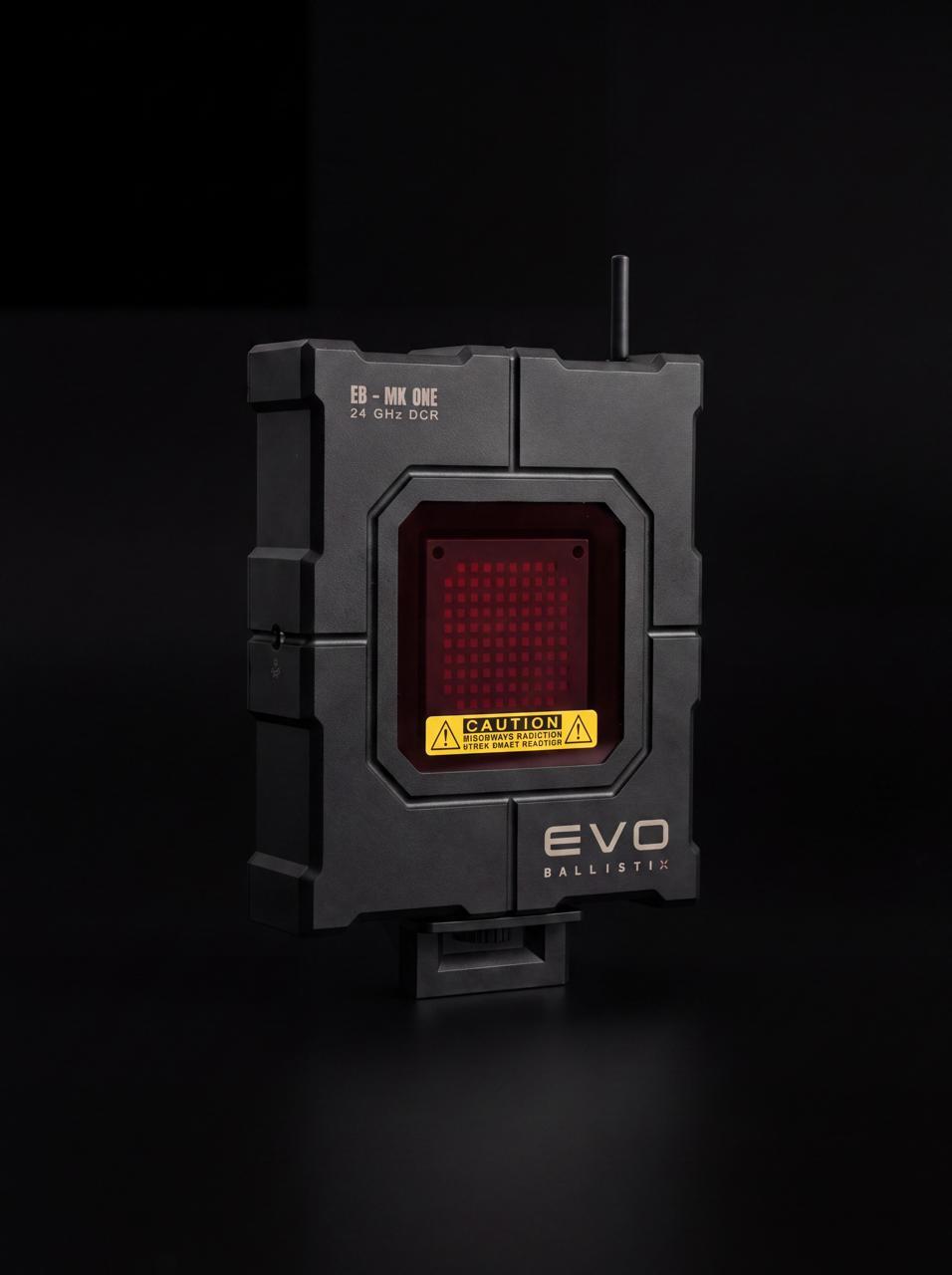
EB-MK ONE · Ballistic Radar & Analyzer
How the EB-MK ONE works, why Doppler radar changed velocity measurement — and an honest look at who actually needs one.
CEBAR Industries · Technical Briefing · ~8 min read
Every ballistic solution — every drop chart, every fire-control profile, every long-range hit — is built on one number: how fast the projectile is actually moving. Get that number wrong by even a small margin and every calculation downstream inherits the error. The EB-MK ONE exists to make that number, and the drag behaviour behind it, a measured fact rather than an estimate.
How the EB-MK ONE Works
The EB-MK ONE is a Doppler radar ballistic analyzer. It transmits a continuous microwave signal downrange. When that signal reflects off a projectile in flight, the reflected frequency is shifted in proportion to the projectile's velocity — the same Doppler effect that raises the pitch of an approaching siren.
Because the radar keeps listening to the projectile as it travels, it doesn't capture one velocity. It captures a continuous velocity-versus-distance profile across the measured flight path. From that profile, the system:
Computes true muzzle velocity
By extrapolating the measured curve back to the muzzle, rather than reading velocity a few metres in front of it and calling it “muzzle velocity.”
Measures real drag behaviour
The rate at which your specific bullet, from your specific barrel, sheds velocity in today's atmospheric conditions.
Derives a measured ballistic coefficient
Replacing the manufacturer's published BC — an average produced under someone else's conditions — with a figure that describes your system.
Why this matters at distance
Published BCs are frequently optimistic, and BC itself changes with velocity. Inside 300 m the error is academic. At 800 m and beyond, a few percent of BC error translates into misses measured in full target heights. A solver fed with measured velocity and measured drag is trued from the first shot — not walked in over a box of ammunition.
Why It's Different From a Traditional Chronograph
“Chronograph” covers two legacy technologies, and both share the same structural limitation: they measure velocity at a single point.
Optical chronographs
Two light screens a fixed distance apart, placed downrange in front of the muzzle. The unit times the bullet's shadow between the screens and computes an average velocity over that short base. The weaknesses are well known to anyone who has used one: readings shift with sky conditions and artificial lighting, the screens demand careful alignment with the bore line, setting up requires a cold range, and the unit itself sits directly in the line of fire — a surprising number of optical chronographs end their service life to a low shot.
Magnetic barrel-mounted chronographs
These clamp a sensor bayonet to the barrel and detect the bullet passing through a magnetic field. They solve the lighting problem but introduce a new one: mass hanging on the barrel changes barrel harmonics, which can shift point of impact and group behaviour. You end up measuring the velocity of a rifle that no longer shoots quite like your rifle. Setup is also per-firearm, and the sensor position relative to the muzzle affects readings.
Doppler radar
The EB-MK ONE sits beside the shooter, on the bench or a tripod, aimed downrange. Nothing is attached to the firearm. Nothing is placed in front of the muzzle. It is indifferent to lighting — indoor ranges, overcast skies, dawn and dusk all read identically — and one unit serves every firearm on the line without reconfiguration. Most importantly, it is the only one of the three technologies that measures the flight rather than a point, which is what makes measured BC possible at all.
| Optical | Magnetic | EB-MK ONE Radar | |
|---|---|---|---|
| Measurement | Single point, short base | Single point at the muzzle | Continuous multi-point tracking |
| Muzzle velocity | Approximated ahead of muzzle | Near-muzzle reading | True MV from measured curve |
| Ballistic coefficient | Not measurable | Not measurable | Measured from velocity decay |
| Lighting | Dependent — sky sensitive | Independent | Independent — indoor or out |
| Effect on firearm | None | Alters harmonics, may shift POI | None — nothing attached |
| Placement | Downrange, in the line of fire | Clamped to barrel, per rifle | Beside the shooter; no cold range |
| Multi-shooter use | One lane, realign per rifle | Remount per firearm | One unit serves the firing line |
Who Actually Needs Radar-Grade Data — and Who Doesn't
Not everyone needs a ballistic radar, and it serves nobody to pretend otherwise. The honest dividing line is simple: does small velocity or drag error change your outcome?
The EB-MK ONE earns its place if you are…
Shooting at genuine distance. Beyond mid-range, trued velocity and measured BC are the difference between first-round hits and walking fire onto target.
Handloading seriously. Extreme spread and standard deviation are the language of load development — radar gives you those numbers shot-for-shot without a fragile downrange setup.
Running a fire-control system. Digital solutions such as the CEBAR D2S are only as good as the ballistic profile behind them. Radar-measured inputs turn a good profile into a verified one.
Responsible for other people's zeroes. Armourers, unit marksmanship programmes and training organisations need documented, repeatable velocity data across many rifles — one radar on the line replaces per-rifle setups.
Developing or validating ammunition. Manufacturers and QC processes need traceable, condition-independent measurement, not weather-dependent readings.
You can reasonably skip it if you are…
Shooting factory ammunition inside ~300 m. The published box velocity plus a confirmed zero will serve you fine.
Plinking and casual range shooting. Velocity data adds nothing to an afternoon of steel at 100 m.
Only patterning shotguns. Pattern boards answer your questions; velocity curves don't.
Content with a basic chronograph's job. If a rough single-point velocity check once a season is all you need, entry-level tools cover it.
If you sit in the second list today but the first describes where your shooting is going, the practical note is this: velocity and drag data compound. The earlier you start building measured profiles for your rifles and loads, the more useful your data library becomes.
Two Editions, One Instrument
The EB-MK ONE is available as the Shooters Edition, configured for individual precision shooters and handloaders, and the Professional Package, specified for organisational, instructional and development use. Both are built on the same measurement core; the difference is in how the data is captured, exported and managed across multiple rifles and users. Speak to the CEBAR team for the specification that matches your programme.
Measured data. Verified solutions.
Stop truing against a guess.
Explore the Shooters Edition and Professional Package, or speak to the CEBAR team about integrating radar-measured ballistic profiles into your programme.
Request InformationFrequently Asked Questions
Is the EB-MK ONE a chronograph?
Not in the traditional sense. A chronograph measures velocity at a single point using light screens or magnetic sensors. The EB-MK ONE is a Doppler radar ballistic analyzer: it tracks the projectile continuously downrange, recording velocity at many points along the flight path. This allows it to report true muzzle velocity and measure how the bullet actually decelerates — data a conventional chronograph physically cannot produce.
How does Doppler radar measure bullet velocity?
The unit transmits a continuous microwave signal. When the signal reflects off the moving projectile, its frequency shifts in proportion to the projectile's speed — the Doppler effect. By measuring that frequency shift continuously as the bullet travels downrange, the radar builds a velocity-versus-distance profile of the entire shot, not a single snapshot.
Why is multi-point tracking better than a single-point measurement?
A single velocity reading tells you how fast the bullet was going at one location. Multi-point tracking shows how the bullet sheds velocity — its real drag behaviour. That lets the system compute a measured ballistic coefficient for your specific rifle, ammunition and conditions, instead of relying on the manufacturer's published figure. At long range, the difference between book BC and measured BC is often the difference between a hit and a miss.
Do I need a ballistic radar if I only shoot at short range?
Usually not. Inside roughly 300 metres with factory ammunition, small velocity errors have little practical effect on point of impact, and a basic chronograph — or no chronograph at all — is often sufficient. Radar-grade data earns its keep when distance, handloading, load development or professional documentation requirements enter the picture.
Does the EB-MK ONE attach to the rifle or affect accuracy?
No. The unit sits beside the shooter on the bench or tripod. Nothing mounts to the barrel, so there is no added weight, no change to barrel harmonics and no shift in point of impact — a known drawback of magnetic barrel-mounted chronographs. There is also nothing placed downrange, so no cease-fire is needed to set up and nothing can be shot.
CEBAR Industries — Precision Optical & Ballistic Technology, Abu Dhabi, UAE · EB-MK ONE · Spectronight · D2S Ballistic

Klara Kozak is the kind of person who launched the world's first pocket chronograph and thought, "what's next?" Now leading International Market Development at CEBAR Industries, she's introducing UAE-built digital scopes, night vision, and ballistic radar to the professionals and competitors who demand more from their optics. She also runs Drekki, a strategy studio built for founders with wild ideas and zero tolerance for beige.
Continue Reading